Growth continues despite of “challenges” of WTO
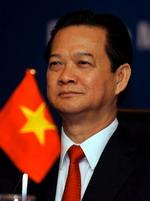 |
| Prime Minister Nguyen Tan Dung |
In 2007, the agricultural production value has mounted to nearly 200,000 billion VND, an increase of 4.6% as compared to 2006. The GDP of agroforestry and fishery grew by 3.4% contributing 0.6 % to the growth of the national economy. The agriculture has maintained a strong development and has better competitiveness power after the country joined WTO. Vietnam continues to be the second largest rice exporter in the world and a largest exporter of robusta coffee and pepper and become one of 10 countries taking lead in exporting fishery products. In the field of agriculture alone, there have been 5 commodities attaining an export value of more than 1 billion VND, which include fishery (3.8 billion VND), wood (2.4 billion VND), coffee (1.86 billion VND), rice (1.46 billion VND) and rubber (1.4 billion VND).
"GDP of agriculture has contributed just about 20.23% to the national economy. However, this has laid a strong foundation for the stability as more than 70% of the country’s population is living in rural areas. Of course, not all rural population earn incomes from agriculture. Instead, 40% of the population is generating incomes from industry and services” said Prime Minister.
Shifting need to be stronger
The shifting of economic structure is slow and shown with a little progress and down from 20.26% (in 2006) to 20.23% (2007) whereas the target set by the government is 19,5%. In addition, the shifting of labor structure has failed to achieve the set out objective especially when 60% of rural population is still engaging in agriculture.
Facing with increased gaps between rich and poor, between rural and urban and between lowland and mountain regions, Prime Minster asked Ministry of Agriculture and Rural Development (MARD) to work out needed measures to reduce the proportion of agricultural GDP. In parallel with this, it is also important to enhance the shifting part of labor from agriculture to industry and services combined with job training.
Solutions
Prime Minister asked MARD to effectively carry out the following three solutions:
First, to review the projection for production, enhance production capacity, increase competivetiveness and ensure for the national food security.
Second, to improve the quality of agricultural production through enhancing investment in science and technology transfer, seed production toward the trend of saving inputs (electricity, water, fertilizer…)
Third, to develop rural infrastructure and rural job training. "To industrialize and modernize the country, there is no other way than to industrialize and modernize the countryside and agricultural sector. Investment in infrastructure, human resource development and allocating enterprises to rural region should become top priorities for the time to come” said Prime Minister.