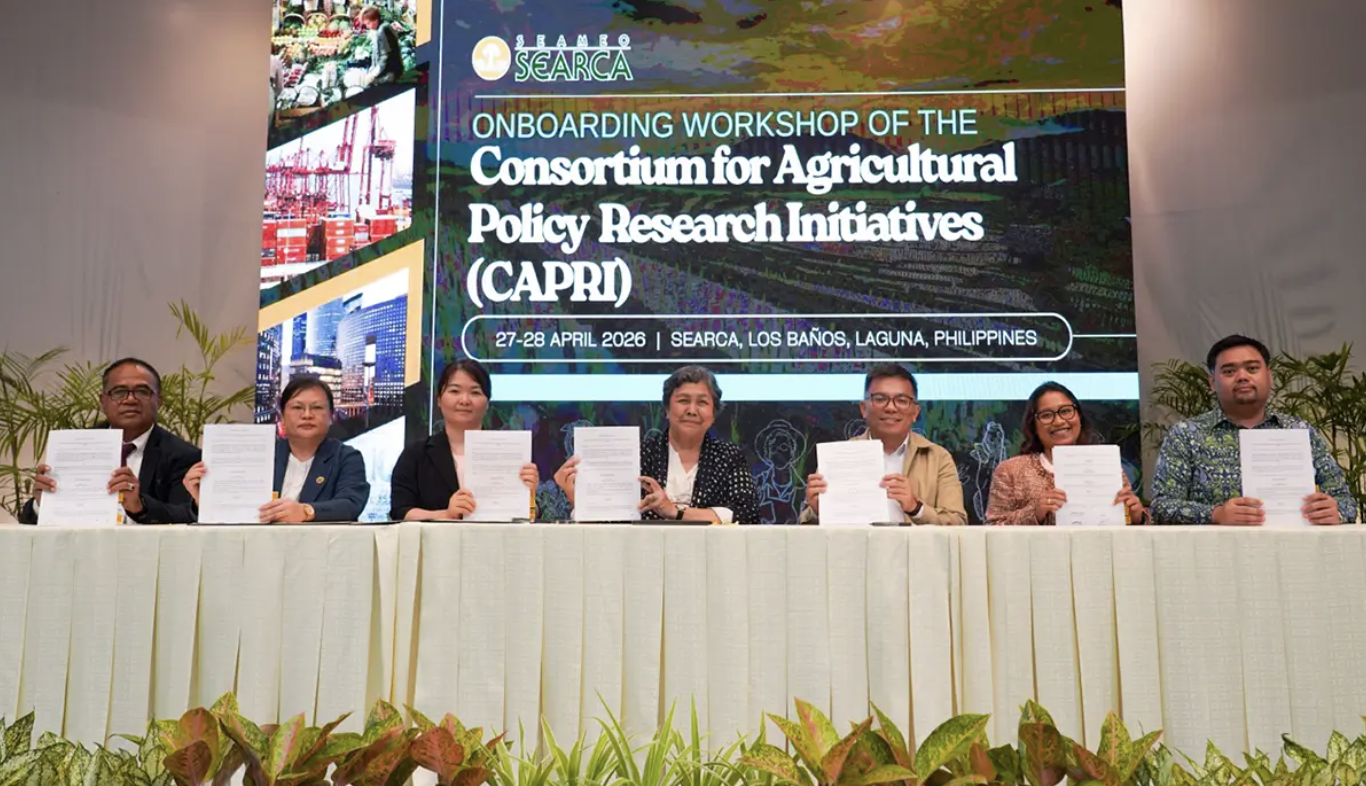
The Consortium collaboration announcement took place on April 28, 2026, during CAPRI’s onboarding workshop convened by the Southeast Asian Regional Center for Graduate Study and Research in Agriculture (SEARCA) on April 27–28, 2026. Anchored on SEARCA’s 12th Five-Year Development Plan: Sustainable Transformation of Agricultural Systems through Innovation in Southeast Asia (SUSTAIN Southeast Asia), the workshop brought together leading agricultural policy research institutions from 11 Southeast Asian countries, along with representatives from SEAMEO, ASEAN, and international development partners.
The participation of research institutions from ASEAN countries underscored CAPRI’s strategic importance in supporting regional agricultural policy research cooperation. With Southeast Asia facing interconnected challenges in food security, climate resilience, trade, rural development, and agrifood systems transformation, CAPRI provides a platform for aligning national research priorities with regional development agenda.
The representative of the Center for Agricultural Policy under the Institute of Strategy and Policy for Agriculture and Environment (ISPAE) from Vietnam and other representatives from other countries’ research institutions participated in and witnessed the event. This participation also reflected active cooperation of the institutions in regional initiative on agricultural transformation, market integration, and evidence-based agricultural policy research across the region.
With the agreement, CAPRI has moved from concept to formal collaboration, establishing a stronger foundation for sustained research cooperation in agricultural policy. The consortium will support thematic working groups, cross-country comparative studies, joint publications, and high-level policy dialogues to strengthen the research-policy interface across Southeast Asia.
Through CAPRI, SEARCA and its partner institutions, including Vietnam’s ISPAE, seek to advance more coherent, inclusive, and evidence-based agricultural policies that support regional priorities in food security, climate resilience, sustainable development, and agrifood systems transformation.